
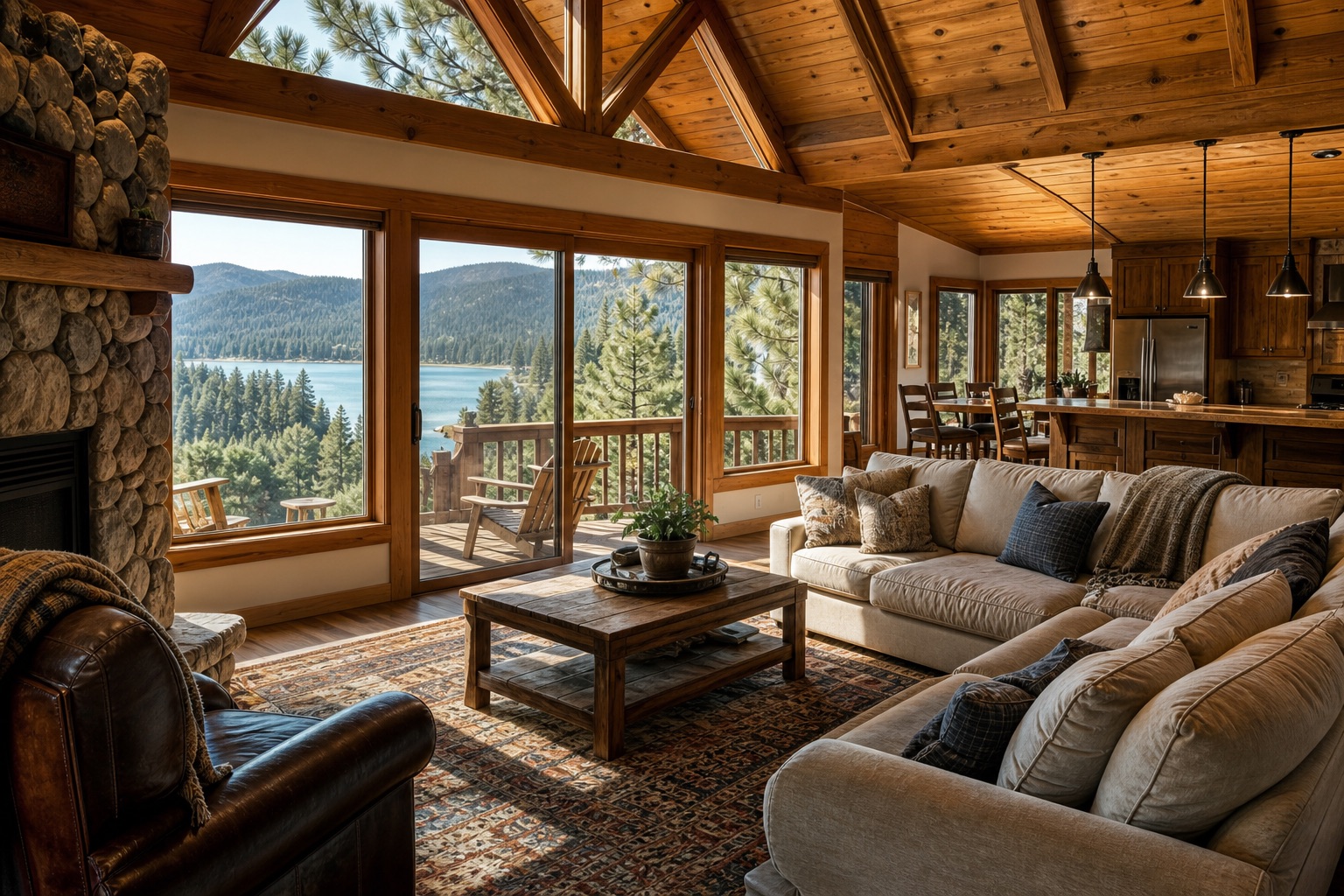
How much cash do you really need to buy a cabin in Big Bear Lake?
At the current median sale price near $550,000, buying a cabin in Big Bear Lake requires more cash than most buyers expect. Your total out-of-pocket will include a down payment, closing costs, prepaid property taxes and homeowners insurance, inspection fees, and a realistic buffer for immediate repairs, all of which must be in hand before (or shortly after) you close.
Key Takeaways
- Recent local market data shows a median sale price of $552,500 in Big Bear Lake, with the middle half of sales over the past six months ranging from roughly $425,000 to $760,000.
- Your total cash need is not just the down payment, closing costs, prepaids, inspections, and post-closing repairs are all separate cash buckets that add up fast.
- San Bernardino County’s base property tax rate is 1% of assessed value under Proposition 13, plus voter-approved local assessments layered on top, buyers fund their share of this at closing through proration and an escrow impound account.
- Big Bear’s older cabin inventory means roof, chimney, and deck inspections are routine, and buyers should plan for a post-closing repair budget as a distinct cash category.
- If you plan to short-term rent the cabin, insurance requirements and potential permit fees create additional upfront cash needs beyond a standard owner-occupant purchase.
What does “cash to close” actually mean for a Big Bear Lake cabin?
“Cash to close” is the total wire you send to escrow on signing day. It is not just the down payment, it is every dollar you need to bring to the table to get the keys. Here is how I break it down for every buyer I work with.
Down payment: the biggest single line item
Your down payment is the largest piece, and it is set by your loan type and lender requirements. Conventional loans for second homes and investment properties in California generally require a higher down payment than a primary-residence purchase, verify the exact requirement with your lender before you write an offer.
To put the numbers in context: Redfin’s Big Bear Lake housing market data shows a median sale price of about $550,000 for the three months ending July 2026, down about 5.2% year-over-year. Recent local market data across the trailing 90 days puts the area median at $552,500. The middle half of sales over the past six months fell between roughly $425,000 and $760,000, according to Resideline’s Big Bear Lake market analysis updated August 2026. Smaller cabins sit well below that midpoint: Trulia’s bedroom-level value estimates as of early September 2026 put 1-bedroom homes around $293,000 and 2-bedroom homes around $416,000, while 3-bedroom and 4-bedroom homes run closer to $596,000 and $822,000 respectively.
Your down payment percentage applied to whichever price tier fits your target property determines the single largest number in your cash-to-close calculation. Get that number from your lender in writing before you start touring.
Closing costs: the category most buyers underestimate
Closing costs are the fees and charges collected at escrow closing that are separate from your down payment. For a financed Big Bear Lake purchase, these typically include lender origination and underwriting fees, escrow fees, title insurance, recording charges, and any points or rate-buydown costs you negotiate with your lender.
Which specific line items fall to the buyer versus the seller is determined by your purchase contract, not by a fixed rule. Local custom in Big Bear Lake plays a role, but everything is negotiable. The Consumer Financial Protection Bureau’s mortgage closing cost explainer is a useful primer on the categories you will see on your Loan Estimate. Your lender is required to give you a Loan Estimate within three business days of your application, that document will show you the actual numbers for your specific loan and purchase price.
I tell buyers to treat closing costs as a real, non-trivial cash item and to get a preliminary estimate from their lender before they finalize their offer budget. Every situation is different, and the only way to know your actual number is to run it with someone who knows this market and your specific loan.
Prepaid taxes and insurance: mandatory cash at closing
Lenders require two prepaid items that are easy to overlook: the first year’s homeowners insurance premium paid in full before or at closing, and an escrow impound account funded with reserves for future tax and insurance payments.
On the property tax side, San Bernardino County’s base secured-roll tax rate is 1% of assessed value for FY 2025-26, set by resolution of the San Bernardino County Board of Supervisors under California’s Proposition 13 framework (California Revenue and Taxation Code sections 93 and 100). That 1% base rate makes up roughly 84-85% of the total effective rate, according to county finance data, voter-approved local assessments and direct charges layer on top of it. At closing, your escrow company will prorate current-year taxes between you and the seller based on your close date. You will also fund an impound account so your lender can pay future tax and insurance bills on your behalf.
For insurance, Big Bear Lake’s mountain and forested setting means wildfire exposure is a real underwriting factor. Insurers treat cabin properties here as higher risk than urban homes, which affects both premium levels and coverage availability. Budget the first-year premium as a required cash item, and confirm with your insurer and lender what the impound reserve requirement will be. The California Department of Insurance consumer guide is a good starting point for understanding your coverage options.
Inspections: cash you spend before you close
Inspection fees are paid directly to inspectors during the contingency period, they are not part of your final wire to escrow. But they are real out-of-pocket cash, and in Big Bear Lake’s older cabin inventory, you should plan for more than a single general inspection.
The inspections I routinely see buyers order here include a general home inspection, a roof inspection, a fireplace and chimney inspection (nearly every cabin has one), and a pest/termite inspection. Decks are worth a close look too, especially on cabins that have served as short-term rentals. Each of these is a separate fee paid to a separate inspector.
You pay these whether or not the deal closes. If you walk away after inspections, those fees do not come back. Budget them as a sunk cost of due diligence, not as part of your closing wire.
Immediate repairs: a cash category buyers often skip
This is the one that catches buyers off guard most often. Big Bear Lake’s cabin inventory skews older, mid-20th-century construction is common, and many of these properties have been used hard as vacation rentals. Inspections regularly surface deferred maintenance on roofs, heating systems, decks, and chimneys.
You can negotiate for repair credits or ask the seller to fix items before closing. But repair credits are not guaranteed, and many cabin sellers in this market price accordingly and expect buyers to handle repairs on their own timetable. I always tell buyers to set aside a separate cash reserve for post-closing repairs, distinct from everything else in their closing budget. What that number looks like depends entirely on the specific property, which is exactly why a thorough inspection matters.
For a deeper look at what different price points actually buy here, the Big Bear cabin investment guide on this site walks through what buyers find at different tiers of the market.
How the current market affects your cash planning
The 2026 Big Bear Lake market is meaningfully softer than it was a year ago. Zillow’s home values data through July 31, 2026 shows an average home value of $542,057, down 3.7% year-over-year. Redfin’s three-month trend through July 2026 shows a similar picture. That softening matters for cash planning in two ways: prices are lower than they were in late 2025, which reduces the absolute dollar size of a percentage-based down payment, and there is more negotiating room on repair credits and seller concessions than there was during the peak.
Here is the area-level market snapshot from recent local data:
| Area | Median Sale Price | Median Days on Market |
|---|---|---|
| Big Bear Lake | $552,500 | 27 |
| Boulder Bay | $145,000 | 48 |
These are area-level medians from trailing 90-day aggregated public listing data as of September 2026. An individual home’s value depends on condition, street, build year, and timing, these numbers give you a frame of reference, not a guarantee.
With 429 active listings and 133 homes sold in the past 90 days, buyers have real selection right now. That inventory level also means sellers are more open to negotiation on terms, which can work in your favor on repair credits and closing cost contributions, though what you can actually negotiate depends on the specific property and offer situation.
If you plan to short-term rent the cabin
Buying as an investment or second home with Airbnb income in mind adds cash planning layers that a straight owner-occupant purchase does not have. Short-term rental properties typically require different insurance coverage than a standard homeowners policy, either a short-term rental endorsement or a separate landlord/STR policy. That affects both your upfront prepaid premium and your ongoing cost structure.
There may also be local permit or registration fees associated with operating a short-term rental in Big Bear Lake, and those rules differ between the City of Big Bear Lake and San Bernardino County depending on the address. I always tell investors to confirm the current STR permit rules for a specific address before they buy, the requirements and associated costs vary and change over time. The City of Big Bear Lake and San Bernardino County are the authoritative sources for current permit requirements.
For more on what the investment side of a Big Bear cabin purchase involves, the Big Bear cabin investment overview covers the key considerations in detail.
How the earnest money deposit fits in
One more cash item worth flagging: your earnest money deposit. In a standard California escrow, you wire a good-faith deposit to escrow shortly after your offer is accepted. That money is credited toward your total cash to close, it is not an additional cost on top of everything else. But it does need to be liquid and available immediately when you go into contract, which matters for cash planning before you make an offer.
Your specific cash-to-close number depends on your loan type, your purchase price, your close date, your insurance situation, and what the inspections turn up. That is where a local market analysis and a real conversation with your lender come in. If you want to run the numbers before you start writing offers, reach out and I will walk you through it.
If you want to see what different price points look like on the ground before you budget, the $735K cabin breakdown and the guide to buying in Big Bear City are both worth reading before you start touring.
Readers who want to see what others have experienced working with me can check my reviews on Google and Zillow.
Frequently Asked Questions
What goes into the cash-to-close number when buying a vacation cabin in Big Bear Lake?
Your cash to close covers five main buckets: your down payment, closing costs (lender fees, escrow, title, recording), prepaid property taxes and homeowners insurance, inspection fees paid during the contingency period, and a post-closing repair reserve. Each of these is a separate cash item, your lender’s Loan Estimate will show you the closing cost and prepaid figures specific to your loan, and your inspection results will shape the repair number.
How much cash should I have ready if I already have a loan pre-approval?
Pre-approval confirms your loan amount, but it does not account for everything you will spend out of pocket. Beyond the down payment, plan for closing costs, the first year’s homeowners insurance premium, your share of prorated property taxes, inspection fees, and a post-closing repair buffer. The exact total depends on your purchase price, loan type, close date, and what inspections turn up, which is why I walk buyers through a realistic cash estimate before they make an offer, not after.
Do I need to pay for inspections upfront, and what should I expect in Big Bear Lake?
Yes, inspection fees are paid directly to inspectors during the contingency period and are not part of your closing wire. In Big Bear Lake’s older cabin market, it is common to order a general home inspection, a roof inspection, a fireplace and chimney inspection, and a pest inspection as separate engagements. Budget these as a real out-of-pocket cost that you will not recover if the deal falls apart.
How are property taxes handled at closing for a Big Bear Lake purchase?
San Bernardino County’s base property tax rate is 1% of assessed value under Proposition 13, with voter-approved local assessments added on top. At closing, your escrow company prorates current-year taxes between you and the seller based on the close date. Your lender will also require you to fund an impound account so future tax payments can be made on your behalf, that initial impound deposit is part of your cash-to-close total.
If I plan to Airbnb my Big Bear cabin, does that change my cash needs at closing?
It can. Short-term rental properties typically require different insurance coverage than a standard homeowners policy, which affects your prepaid insurance amount at closing. There may also be local permit or registration fees depending on whether the property is in the City of Big Bear Lake or in the unincorporated county area. These are additional cash categories to investigate before you write an offer, the rules differ by address and have changed over time, so confirm directly with the relevant local authority.
The bottom line on cash planning for a Big Bear Lake cabin
The down payment is only the starting point. At today’s median near $552,500, your total cash need includes closing costs, prepaid taxes and insurance, inspection fees, and a post-closing repair reserve, and if you are buying for short-term rental, there are additional insurance and permitting costs to factor in. Every situation is different, and the only way to know your real number is to run it with someone who knows this market and your specific loan.
I walk buyers through a realistic cash estimate before we ever write an offer. If you want to know what your number looks like, reach out and let’s talk through it.
Equal Housing Opportunity. Rachael Smith-Meadors, Broker Associate, California Department of Real Estate. This article is general information only and does not constitute legal, tax, or financial advice, confirm your specific numbers with your closing agent, tax advisor, or lender.