
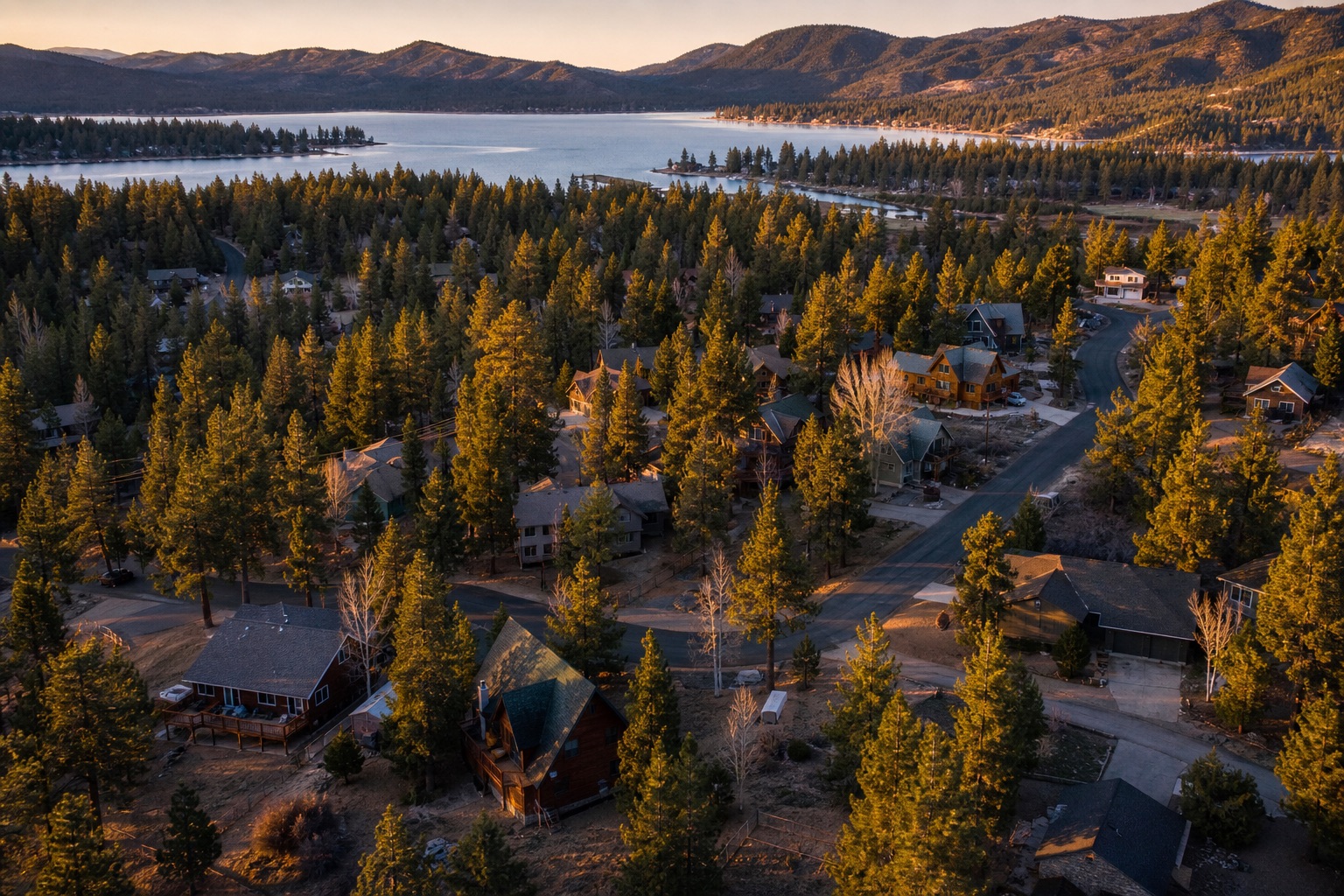
Is investing in a Big Bear Lake cabin worth it in 2026?
Big Bear Lake cabins can be strong short-term rental investments, but success depends on confirming STR permit eligibility, paved parking, and the right neighborhood before you make an offer. The area median sale price sits around $557,500 as of August 2026, with homes selling in roughly 40 days, and the right cabin in the right location can generate meaningful rental income year-round.
Big Bear Lake has a specific kind of pull. It’s not just a mountain town, it’s one of Southern California’s most accessible year-round escapes, sitting about two hours from Los Angeles and drawing skiers in winter, hikers and boaters in summer, and leaf-peepers every fall. That demand is what makes the cabin market here so interesting for investors.
But “cabin investment” means something different in Big Bear than it does in a lot of mountain markets. The city has a real, active short-term rental permitting program, and the rules matter more than most buyers realize when they’re browsing listings. I’ve watched buyers fall in love with a property only to discover it can’t be permitted as a vacation rental, or that the lot doesn’t meet the parking requirement. Getting those details right before you write an offer is the whole game.
The Big Bear Cabin Market Right Now
The market has softened from its pandemic-era highs, and that’s actually good news for buyers who sat on the sidelines. Redfin’s Big Bear Lake market data showed a median sale price of $546,000 over the three months ending June 2026, down about 7.5% year over year. Zillow’s home-values page put the typical home value at $547,858 through February 2026, also reflecting that same downward trend.
More recent Zillow market data through August 2026 puts the area median sale price at $557,500, with homes spending a median of 40 days on market. There are currently 447 active listings and 87 new listings added in just the last 30 days, which tells you there’s real inventory to work with right now. About 128 homes have closed in the last 90 days.
The takeaway: prices have moderated, inventory is up, and buyers have more negotiating room than they did two or three years ago. For an investor with a long view, this is a more favorable entry point than the frenzied market of 2021-2022.
Here’s how the areas I work in compare, based on recent sales data:
| Area | Median Sale Price | Median Days on Market |
|---|---|---|
| Big Bear Lake | $557,500 | 40 |
| Boulder Bay | $145,000 | 54 |
| Fawnskin | $382,000 | 25 |
These are area-level medians from recent Zillow sales data, an individual cabin’s value shifts based on condition, lot, build year, and street. Boulder Bay’s lower median reflects a mix of property types and lot sizes rather than a uniform price tier. Fawnskin’s faster pace (25 days) is worth noting for buyers who want to move deliberately, properties there have been moving quickly.
For a closer look at what specific price points actually buy you here, the Big Bear Airbnb investment breakdown I put together earlier this year walks through the STR revenue math in more detail.
The STR Permit Rules: What Investors Must Know Before Buying
This is where a lot of out-of-area buyers get tripped up, and it’s the first thing I walk through with any investor client.
The City of Big Bear Lake runs an active Transient Private Home Rental (TPHR) program, with an approved vacation rental list that was updated as recently as July 2, 2026. That list is live and changing, which means the permitting landscape is real, not theoretical.
Here are the rules that affect investment feasibility most directly, per the city’s vacation rental program materials:
- Paved off-street parking is required. Existing rental units must have off-street paved parking, and new rental units cannot be permitted without it. A cabin with a dirt driveway or no dedicated parking may not qualify.
- Two-license cap per owner. One owner cannot hold more than two vacation rental licenses. If you’re building a portfolio, that ceiling matters.
- A city business license is required. The City’s Business Licenses Division handles vacation-rental business license renewals and is the direct contact point for operators.
The rules also cover occupancy limits and other operational requirements, the city’s program is not just a tax mechanism. It’s a full licensing framework with real teeth. I always tell investors to confirm the current STR permit status and eligibility for a specific address before they buy, because city and county rules differ, and the rules do change.
If you’re weighing a cabin in Big Bear City (which falls under San Bernardino County rather than the City of Big Bear Lake), the rules are different again. I cover that distinction in the Big Bear City cabin buying guide.
What Makes a Cabin a Good STR Candidate
Beyond the permit eligibility, there are property-level factors that separate a strong STR performer from a money pit:
- Lot layout and parking. Paved, off-street parking isn’t just a city requirement, guests expect it. A cabin with a proper driveway and parking for 2-3 vehicles will outperform one that requires street parking.
- Bedroom and bathroom count. More sleeping capacity generally means higher nightly rates. A 3-bed/2-bath cabin in good condition is a very different revenue story than a 1-bed/1-bath.
- Condition and amenities. Hot tubs, updated kitchens, and game rooms consistently drive higher occupancy and reviews on platforms like Airbnb and VRBO. Guests in this market have options.
- Proximity to ski lifts and the lake. Moonridge cabins near Bear Mountain and Snow Summit draw a different (and often repeat) guest profile than cabins further out. Walkability to the village or the lake adds a summer-season premium.
- HOA restrictions. Some communities restrict or prohibit short-term rentals entirely. Always verify HOA rules alongside city permit rules.
Run the STR revenue numbers before you make an offer. The right neighborhood and the right property layout matter far more than how good the listing photos look. I’ve seen beautifully staged cabins that are terrible rental investments, and modest-looking properties that generate strong cash flow because the fundamentals are right.
Rustic vs. Modern: Which Cabin Type Performs Better?
Big Bear’s cabin inventory runs the full spectrum, from 1960s A-frames with original wood paneling to newly built or fully renovated mountain-modern homes with vaulted ceilings, chef’s kitchens, and spa bathrooms. Both can work as investments, but they serve different guest segments and require different management approaches.
Rustic cabins tend to carry lower purchase prices and can appeal to guests seeking an “authentic” mountain experience. The tradeoff is higher maintenance costs over time and potentially lower nightly rates. Modern or fully renovated cabins typically command higher nightly rates and attract guests who expect hotel-level amenities, but they also carry higher acquisition costs and often higher property taxes.
The best investment isn’t always the shiniest one. It’s the one where the numbers work after you account for mortgage, property taxes, HOA fees (if applicable), management fees, maintenance reserves, and the city’s business license costs. Every situation is different, and the only way to know for sure is to run the full picture with someone who knows this market.
If you want to see what different price points actually deliver in Big Bear, check out the cabin tour at $335,000 in Big Bear City or the Sugarloaf cabin tour at $275K for a grounded sense of what the market looks like at different entry points.
For buyers interested in the top of the market, Big Bear lakefront homes represent a different investment thesis entirely, higher acquisition cost, but a premium rental category with strong demand and limited supply.
According to NAR’s research on vacation home markets, second-home buyers increasingly cite rental income potential as a primary purchase motivator, a trend that’s very visible in Big Bear. But national data doesn’t tell you whether a specific cabin on a specific street in Moonridge or Fawnskin will pencil out. That’s a local question that needs a local answer.
The CFPB’s homebuying resources are worth reviewing if you’re financing a second home or investment property, lender requirements for non-primary residences differ from primary home purchases, and it’s worth understanding those distinctions before you’re under contract.
If you’re ready to get specific, I’m happy to pull live MLS data on properties that fit your criteria and walk through the STR feasibility on any cabin you’re considering. That’s exactly the kind of work I do before my clients ever write an offer.
If you’d like to know what your current cabin is worth in this market, you can get a free home valuation here.
You can read what past clients say about working with me on Google and Zillow.
Frequently Asked Questions
What permits do I need to operate a short-term rental in Big Bear Lake?
Properties within the City of Big Bear Lake must be approved under the city’s Transient Private Home Rental (TPHR) program and hold a city business license. The approved vacation rental list is actively maintained, it was updated as recently as July 2, 2026. Properties in Big Bear City fall under San Bernardino County rules, which are separate. Always verify the permit status of a specific address before purchasing.
Are there parking requirements for Big Bear Lake vacation rentals?
Yes. Per the city’s vacation rental program, existing rental units must have off-street paved parking, and new rental units cannot be permitted without it. This is a hard requirement that affects which properties can qualify as STRs, a cabin with only a dirt driveway or no dedicated parking may not be eligible.
How many vacation rental licenses can one owner hold in Big Bear Lake?
The City of Big Bear Lake caps ownership at two vacation rental licenses per owner. If you’re planning to build a multi-property STR portfolio within city limits, that two-license ceiling is a real constraint to factor into your strategy from the start.
Do Big Bear Lake vacation rentals need a city business license?
Yes. The City’s Business Licenses Division handles the business licensing process for vacation rental operators, including renewals. This is separate from the TPHR permit, you’ll need both to legally operate a short-term rental within city limits.
What are the latest Big Bear Lake housing market trends for cabin buyers?
As of August 2026, the area median sale price sits around $557,500 based on recent Zillow market data, with homes spending a median of 40 days on market. The market has softened from pandemic-era peaks, Redfin data showed prices down about 7.5% year over year through June 2026, which means buyers have more inventory and more negotiating room than they did in 2021-2022. With 447 active listings currently, this is a more buyer-friendly environment than the valley has seen in several years.
This article is general information only, not legal, tax, or financial advice. STR permit rules, tax rates, and market conditions change; confirm your specific situation with your attorney, tax advisor, lender, or escrow officer. Broker fees and commissions are fully negotiable and not set by law. Equal Housing Opportunity. Rachael Smith-Meadors, Broker Associate, regulated by the California Department of Real Estate.