
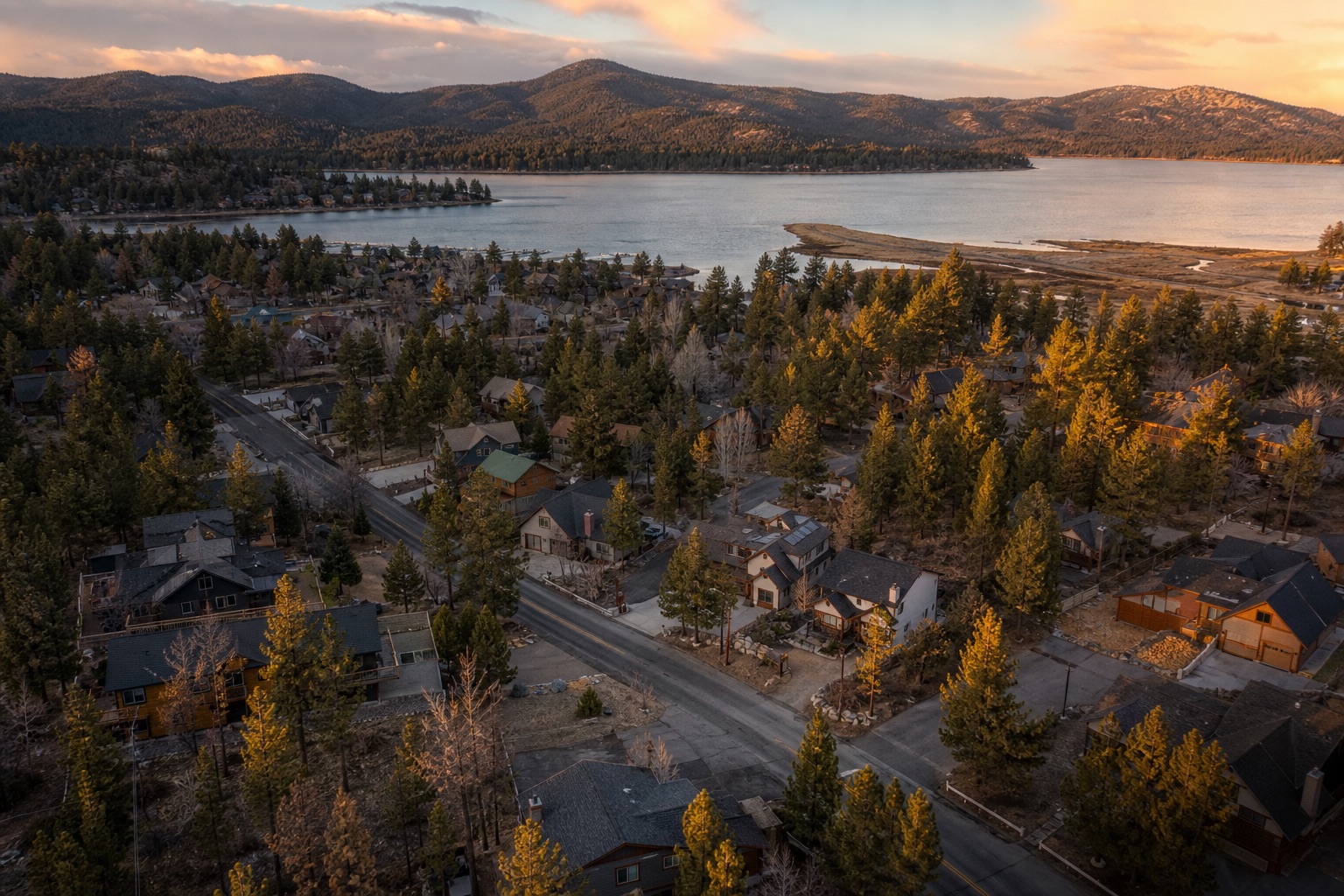
What should Big Bear Lake STR and second-home owners do when the market feels like it’s crashing?
In a soft 2026 market, Big Bear Lake STR and second-home owners have three realistic options: hold as a short-term rental if your reserves can absorb a non-cash-flowing period, convert to a long-term rental to eliminate lodging-tax compliance overhead, or price the property near current market medians and sell now. Waiting for prices to recover to 2021–2022 peaks while carrying a negative-cash-flow STR is the one path that tends to make the situation worse.
Key Takeaways
- Big Bear Lake’s median sold price over the most recent six-month period (roughly March–August 2026) was approximately $530,000, down 5–7% year-over-year, according to recent market data from multiple tracking sources.
- Homes in Big Bear Lake are spending roughly 80–110 days on market before going under contract in Q3 2026, and about 76–77% of sales close below the asking price.
- City of Big Bear Lake STRs carry a combined 13% lodging tax (TOT plus TBID) on gross rental receipts, due monthly, even in months with zero bookings.
- With more than 10 months of inventory in the market as of late summer 2026, sellers who anchor to peak-era pricing face significantly longer days on market and a higher chance of selling below list anyway.
- Converting to a long-term rental eliminates the STR lodging-tax filing obligation and inspection/renewal burden, but requires a separate cash-flow analysis against current local lease rates before committing.
What does “crashing” actually look like in Big Bear Lake right now?
“Crash” is a strong word, and it’s worth being precise. What Big Bear Lake owners are experiencing as of September 2026 is a genuine, measurable market softening, not a collapse, but real enough to hurt if you’re carrying debt from a 2021 or 2022 purchase.
According to Resideline’s Big Bear Lake housing market data (last updated August 29, 2026), the median sold price over the most recent six-month period is approximately $530,000, with the middle half of sales closing between roughly $425,000 and $740,000. That’s a real number to anchor your expectations to, not a Zestimate, not a list price.
National portals corroborate the softness. Redfin’s Big Bear Lake market trends page (updated September 3, 2026) shows a median sale price of about $550,000 over the last three months, down roughly 5% year-over-year, and characterizes the market as “not very competitive.” Zillow’s Big Bear Lake home-values page shows average home values down about 7% over the past year, with a median sale-to-list ratio near 0.97 and approximately 76–77% of sales closing below asking price.
Recent local market data (aggregated public listing data, trailing approximately 90 days as of September 2026) shows the Big Bear Lake area with a median sale price of $577,500 and a median of 22 days on market for properties that do sell, but active inventory is elevated and new listings continue to come on. The market table below shows how conditions compare across two key areas in the valley.
| Area | Median Sale Price | Median Days on Market |
|---|---|---|
| Big Bear Lake | $577,500 | 22 |
| Fawnskin | $304,625 | 23 |
Those medians reflect what’s actually closing, properties priced and positioned well. The broader picture, including the 80–110 days many cabins sit before going under contract and the 10-plus months of total inventory, tells you what happens when a listing is priced at last year’s expectations. Realtor.com’s Big Bear Lake market page explicitly characterizes this as a buyers’ market, meaning inventory exceeds demand and buyers have real negotiating leverage.
For an owner who bought or refinanced near the 2021–2022 peak, a 5–7% price decline combined with 90-plus days to contract and a non-cash-flowing STR feels a lot like a crash, even if the headline number isn’t dramatic. That feeling is legitimate. The question is what to do about it.
Why STRs feel the pain first
A second home you’re not renting just sits there quietly. An STR in a soft market generates active friction every single month.
City of Big Bear Lake STR owners are subject to a combined 13% lodging tax on gross rental receipts, the city Transient Occupancy Tax plus the Tourism Business Improvement District (BBLTBID) assessment, remitted monthly, with returns due by the end of the month following the reporting period, according to Tenby’s Big Bear STR laws guide (updated August 20, 2026). That filing is due even in months when you had zero bookings.
For comparison, STRs in unincorporated San Bernardino County areas (parts of Big Bear City, Fawnskin, and other areas outside city limits) carry a lower combined burden, roughly 9% total (7% county TOT plus TBID), per Bnbcalc’s San Bernardino County STR regulation guide, which cites San Bernardino County Code § 14.0203. The jurisdictional line matters when you’re running cash-flow projections or comparing a city property to a county one.
On top of the tax drag, city STR owners must maintain an active license, pass an annual owner certification exam, complete a pre-rental inspection, and renew on schedule. The Tenby guide notes that renting before the license and inspection are complete is prohibited, and that the registration-plus-inspection process typically takes two to four weeks. Non-compliance, skipped filings, under-reporting, or renting without a valid license, can result in fines and suspension or revocation of the STR license. When bookings are down and cash is tight, that compliance clock keeps running regardless.
I always tell investors to confirm the current STR permit rules for a specific address before they buy, because city and county rules differ and change over time. That same advice applies when you’re deciding whether to hold: make sure you know exactly which jurisdiction your property sits in and what the current obligations are, because the cost difference between a city STR and a county STR is material when you’re already running negative.
What are your three realistic options?
Option 1: Hold as an STR and ride out the cycle
This makes sense if your financing is solid, your reserves can absorb six to twelve months of reduced or negative cash flow, and you genuinely believe Big Bear Lake’s tourism fundamentals will recover. Big Bear is a real destination, lake in summer, snow in winter, and that doesn’t disappear because of a soft housing market.
But be honest with yourself about the math. Gross bookings are down, guest price sensitivity is up, and your fixed costs (mortgage, insurance, utilities, maintenance, license renewal, and monthly TOT filings) don’t flex with occupancy. If you’re already negative and you don’t have reserves to cover the gap, holding is just deferring a harder decision while the equity clock ticks.
One thing I’d caution against: banking entirely on next winter’s ski season to fix a structural cash-flow problem. Seasonality might boost bookings and buyer interest, but the 2026 inventory and price trend data suggest it’s unlikely to fully offset a year-round negative position. Evaluate the full-year numbers, not just the peak months.
Option 2: Convert to a long-term rental
A long-term rental (typically 31 days or more) eliminates the STR lodging-tax filing obligation and removes the inspection, certification exam, and renewal cycle from your plate. You trade volatile short-term income for something more predictable, and you step off the monthly compliance treadmill.
The trade-off is that long-term rents in a mountain resort market are generally lower than peak STR revenue in a strong booking year. The question is whether current STR revenue, after 13% lodging tax, platform fees, cleaning, maintenance, and compliance costs, actually beats a steady long-term lease right now. In a soft booking environment, that gap closes faster than most owners expect.
Before converting, check current lease rates in your specific neighborhood against your carrying costs. If the long-term rent covers your mortgage and fixed expenses with a reasonable cushion, conversion buys you time without the compliance overhead. If it doesn’t, you’re still negative, just with less paperwork.
For a deeper look at what investment decisions look like in this market, my Big Bear lakefront investment guide walks through the framework I use with clients who are weighing hold-versus-sell decisions.
Option 3: Price it to sell now
If your reserves are thin, your financing is stretched, and you’re watching equity erode month by month, selling now at a realistic price may be the most financially sound move, even if it means accepting less than you paid or less than you hoped.
The key word is “realistic.” With roughly 76–77% of Big Bear Lake sales closing below asking price and median days to pending stretching past three months for overpriced listings, anchoring to a 2021–2022 peak price doesn’t protect your equity, it just extends the time you’re carrying a negative-cash-flow property. Sellers who price near current market medians and adjust quickly are the ones moving within the 80–110 day window. Sellers who hold out for pre-correction pricing often end up accepting a lower price anyway, after months of additional carrying costs.
I price every listing from live local MLS data, not a national estimate, because Big Bear doesn’t follow SoCal averages and the difference between a correctly priced cabin and an overpriced one in this market is measured in months, not days. Your specific number depends on your home’s condition, location, build year, and current comparable sales, that’s exactly what a current market analysis is for.
For practical guidance on positioning a listing in a slow market, my post on how to sell your home in a slow market in Big Bear covers the mechanics in detail. And if you’re still weighing whether now is the right moment, this post on timing a Big Bear sale addresses the tradeoffs directly.
A note on costs and what to expect at closing
Selling in any market comes with transaction costs, title insurance, escrow fees, prorated property taxes, HOA transfer fees if applicable, and documentary transfer tax, among others. Some of these are fixed by statute or close date; others are negotiable between the parties. Broker compensation is fully negotiable and not set by law, there is no standard or customary rate, and any compensation a seller chooses to offer a buyer’s agent is optional and separately negotiable from the listing-side fee. For a personalized picture of what you’d net after all costs, that’s a conversation worth having before you decide which path to take. I’m happy to walk through a net sheet with you directly.
According to NAR’s research and statistics, sellers who work with a local agent and price accurately from the start consistently outperform those who start high and reduce, a pattern I see play out in Big Bear specifically, where the buyer pool for cabins and STRs is smaller and more price-sensitive than a primary-home market.
If you want to see where your property stands right now, a free home valuation is a good starting point before you commit to any of the three paths above.
I’ve worked with buyers and sellers across this market for 15-plus years, and the owners who come out of a down cycle in the best shape are the ones who made a deliberate choice early, not the ones who waited to see what happened. Read what my clients have to say on Google or Zillow.
FAQ
Is the Big Bear Lake housing market actually crashing in 2026 or just cooling off?
It’s a real and measurable softening, not a collapse. National portals report year-over-year price declines of 5–7% and a median sale-to-list ratio near 0.97, with roughly 76–77% of sales closing below asking price as of 2026. For owners who bought or refinanced at 2021–2022 peak valuations, that feels like a crash, but the underlying tourism demand for Big Bear Lake hasn’t disappeared, and prices haven’t fallen off a cliff.
What are my options if my Big Bear Airbnb or VRBO isn’t cash-flowing anymore?
You have three realistic paths: continue holding as an STR if your reserves can cover the gap, convert to a long-term rental to shed the 13% combined lodging-tax burden and compliance overhead, or price aggressively and sell into the current market before further equity erosion. The right answer depends on your financing, your cash reserves, and how long you can realistically carry a negative position, which is worth running through with a local agent before committing to any of them.
Should I convert my Big Bear vacation rental to a long-term rental instead of selling?
Converting to a long-term rental (31 days or more) eliminates the city’s monthly TOT/TBID filing obligation and removes the STR inspection and annual certification requirements, which reduces both cost and administrative burden. The trade-off is that long-term rents are typically lower than peak STR revenue, so you need to verify that current local lease rates actually cover your mortgage and fixed expenses before making the switch. If the numbers work, it’s a legitimate way to buy time without selling in a soft market.
How long are homes taking to sell in Big Bear Lake in 2026, and what does that mean for pricing?
Many cabins and second homes are spending roughly 80–110 days on market before going under contract in Q3 2026, based on portal and brokerage data, and the overall market is carrying more than 10 months of inventory. That means overpriced listings sit, accumulate days on market, and often end up accepting a lower price anyway after months of additional carrying costs, so pricing near current comparable sales from day one matters more in this market than in a competitive one.
In a buyers’ market, is it better to drop the price on my Big Bear cabin or wait for the next snow season?
Seasonality can boost both bookings and buyer interest heading into winter, but the structural softness in 2026, elevated inventory, longer days on market, and year-over-year price declines, is unlikely to be fully resolved by one peak season. If you’re carrying a non-cash-flowing STR, waiting for winter without addressing the pricing or hold-versus-sell decision means absorbing additional months of carrying costs with no guarantee of a better outcome. A current market analysis will tell you whether a price adjustment now or a strategic hold makes more sense for your specific property.
What lodging taxes do I pay on a Big Bear Lake short-term rental versus a place in the county?
City of Big Bear Lake STRs are subject to a combined 13% lodging tax on gross rental receipts (city TOT plus the BBLTBID assessment), remitted monthly even in zero-booking months. STRs in unincorporated San Bernardino County areas, which include parts of Big Bear City, Fawnskin, and other communities outside city limits, carry a lower combined burden of approximately 9% (7% county TOT under San Bernardino County Code § 14.0203, plus TBID). The jurisdictional line is critical when you’re projecting cash flow or comparing hold-versus-sell decisions across properties with different addresses.
Equal Housing Opportunity. Rachael Smith-Meadors, Broker Associate, California Department of Real Estate. This article is general information only and is not legal, tax, or financial advice. Confirm your specific numbers with your closing agent, tax advisor, or lender before making any transaction decisions.